

In Part 1 of this series, we talked about one of the biggest responsibilities on an athletic director’s plate: evaluating coaches. But evaluations shouldn’t stop there. To get a full picture of your athletic department, you need to inspect all moving parts.
Most athletic departments already hand out end-of-season surveys, but let’s face it: Too many of those surveys turn into a box-checking exercise. Athletes rush through them, the results are skimmed, and nothing really changes. If you want your surveys to actually make a difference, here’s how to shake things up…
Where Surveys Fall Flat
Recycled questions.
When athletes see the same list of questions year after year, their responses get stale too. They’ll throw in one-word answers or skip open-ended sections altogether. If the questions don’t feel fresh or relevant, neither will the feedback.
Too long.
Length is another killer. After a long season, athletes don’t want to spend half an hour on a survey. Long forms encourage rushed answers — or worse, no answers at all. Keep it manageable, or your data will be full of half-hearted responses.
No follow-up.
Here’s the biggest problem: Results get collected, but nothing happens afterward. What’s the point of surveying at all if the data collected only builds dust in a file cabinet? If athletes don’t see changes, or at the very least receive some communication regarding their input, they’ll stop taking surveys seriously.
How to Make Surveys Count
1. Ask better questions.
Focusing on solely generic yes/no or number ranking questions won’t cut it anymore. Add diverse question structures and emphasize short, specific prompts that encourage reflection. For example: “What did we do this season that worked really well?” pushes athletes to highlight strengths, while “What should we do differently next year?” gives them space to identify gaps. Don’t forget to treat your athletes as a whole — ask about their experience with academic, mental, and physical support.
2. Keep it short.
Remember: End-of-season surveys are akin to a post-game huddle, not a three-hour film session. A good survey should take 10 minutes maximum. When athletes know they can finish quickly, they’re more likely to give thoughtful, genuine answers instead of rushing through to hit submit.
3. Encourage honesty.
If they’re worried their feedback will come back to bite them, athletes won’t open up. Anonymity is preferred if you’re looking for blunt, useful insights. If true anonymity isn’t possible, it should be emphasized that responses are strictly confidential and will only be used to improve the program, not single anyone out.
4. Explain the why.
The why is the most important part. Athletes need to know their time and opinions are taken seriously. Before you hand out surveys, explain what you’ll do with the feedback and how it could shape decisions for next year. Whether it’s equipment upgrades, scheduling adjustments, or better mental health support, connecting the survey to real outcomes motivates athletes to take it seriously.
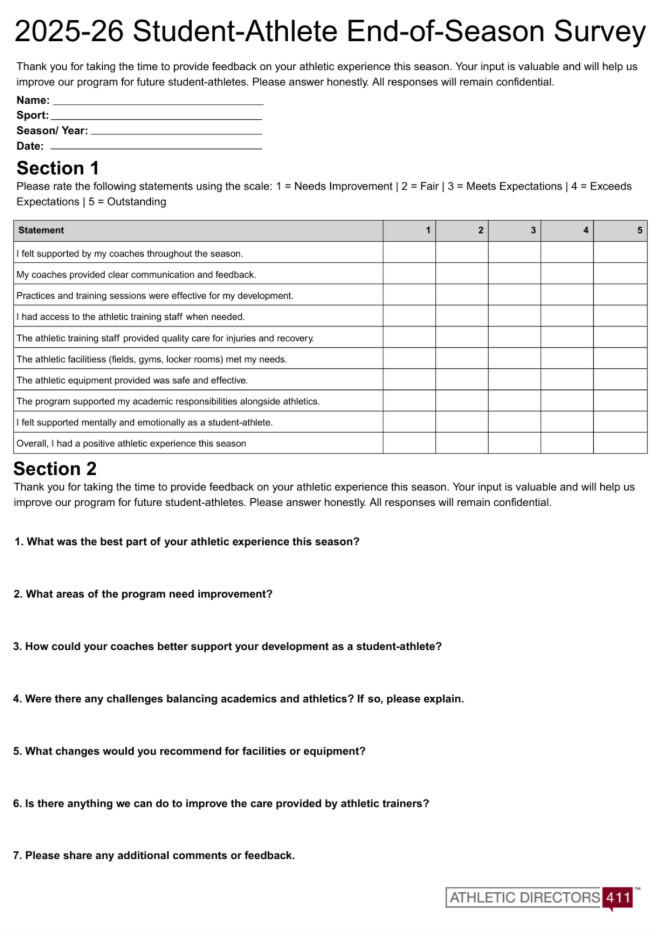
Sample End-of-Season Student-Athlete Survey
From Data to Action
Surveys are only as valuable as the action you take afterward. Once you’ve gathered data, don’t just file it away … Show athletes that their voices matter:
- Share the big takeaways. You don’t need to release every single survey line, but let your athletes know the major themes you heard. It builds transparency and shows you’re listening.
- Pick a few wins. You can’t fix everything at once, and some of the things athletes wish for may be way out of your grasp — that’s okay. Narrow in on two or three achievable changes you can roll out quickly. Small, visible wins build momentum and credibility.
- Close the loop. At the start of next season, remind athletes of the adjustments you made because of their feedback. When they see real improvements tied directly to their input, they’ll be more willing to participate honestly in the future.
Athletic director evaluations are up next in Part 3 of this series. We’ll flip the script and talk about how you can assess yourself and invite the right feedback on your own leadership — what to ask, how to structure it, and how to turn it into growth that benefits your entire department.