
If you have access to the Internet or cable TV, then chances are you’ve seen the recent video that has led the U.S. Men’s Hockey team into hot water. On the off-chance you haven’t seen it, I’ll sum it up for you: Last week after beating Canada 2-1 in overtime for the gold medal, the U.S. men’s team was recorded on a phone call with President Trump, who was inviting the team to his State of the Union Address. Near the end of the video, the president joked that he would need to invite the women’s team as well, or else, he stated, “I do believe I would probably be impeached.”
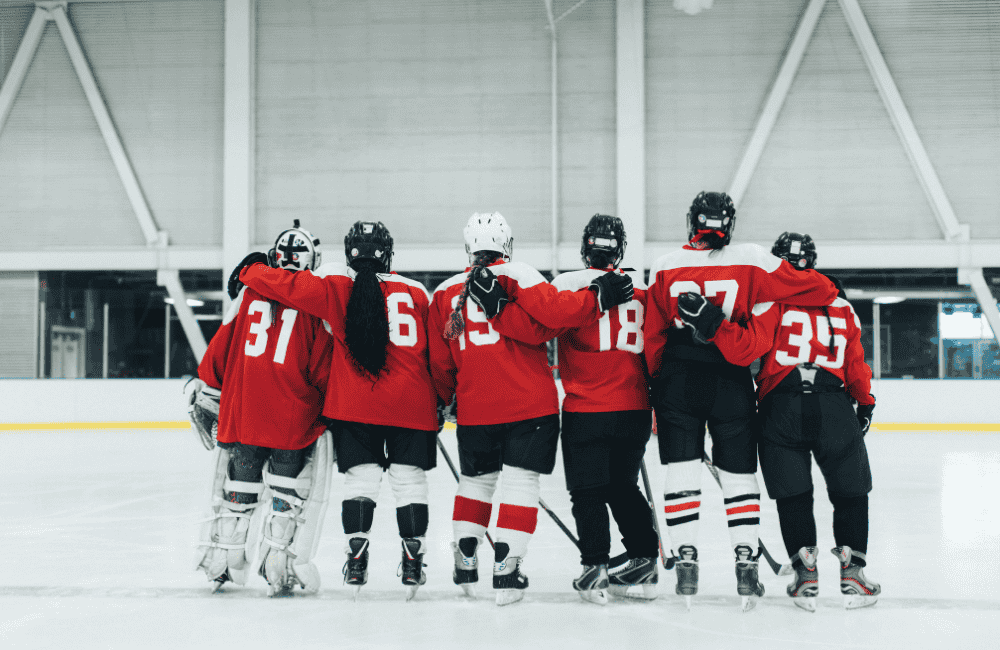
Save for one player who excitedly yelled “TWO FOR TWO,” the whole team exploded in laughter. As if the women’s hockey team did not also beat Canada 2-1 in overtime to win the gold medal. As if the women’s team did not also pour countless hours and dollars, blood, sweat, and tears into their sport to be recognized by their country.
Why this moment matters
Some have claimed that the players were “just celebrating their win,” or that those offended are “thinking too much into it.” I disagree. Women’s sports have been discredited for too long, and we are past the point of brushing off instances like this as harmless. The actions of the U.S. Men’s Hockey team were disheartening. Of course, as a female hockey fan, they were saddening. But as a former female athlete, they were not surprising in the least.
And here is where athletic directors need to lean in — because what happened in that video isn’t singular. It happens daily on buses, in weight rooms, and across campuses.
The impact on female athletes
Subtle misogyny rarely looks like blatant discrimination. It shows up in jokes, in scheduling, in who gets prime practice time. It shows up in who gets new uniforms first, in which team’s wins get morning announcements and which ones get a quick social media post. It also shows up in how boys react when girls succeed.
Athletic directors may not think a laugh on a phone call matters. But your athletes are watching. Your female athletes are wondering if they will ever be fully valued or respected. And the data tells us they are already walking away. Girls drop out of youth sports at roughly twice the rate of boys. The reasons are layered, but culture plays a role. When girls feel overlooked, underfunded, or subtly dismissed, participation becomes harder to justify.
What athletic leaders should examine
Rarely is culture shaped by major scandals, but instead by small moments that go unchecked — so, what should athletic leaders look for?
Listen to how coaches talk about girls’ teams. Are they described as “scrappy” while boys are described as “dominant”? Pay attention to resource allocation. Are facilities equitable in condition and access? Review who receives promotional support. Are girls’ championships celebrated with the same visibility and enthusiasm?
And then, perhaps most importantly, examine locker room norms. Are male athletes taught to celebrate their own success without diminishing others? Do captains receive leadership training that includes respect across gender lines? Are athletes held accountable for the comments they make — whether that be a joke under their breath or a bold statement? Subtle misogyny thrives when it is written off, but it fades in environments where standards are clear.
Respect must be the standard
You don’t have to police every laugh, but you do need to work towards a department where respect is not optional. That means coaches correcting dismissive comments in real time, and student-athletes understanding that every person in the program deserves equal respect and celebration.
The gold medal video will eventually fade from headlines, but the way every female athlete felt when they watched it will not.